<h1 align='center'>图论与最短路径算法</h1>
图
图的定义
对于平面上的若干点,把这些点用曲线或直线连接起来,不考虑点的位置与连线的曲直长短,这样形成的关系结构就是图.
例如以下两张图就是同一个图。(把节点抽象出来只剩下数据)
<img src="./assets/image-20250112220333374.png" alt="image-20250112220333374" style="zoom:50%;" /> <img src="./assets/image-20250112220341989.png" alt="image-20250112220341989" style="zoom:50%;" />
图的分类
- 有向图(节点之间用箭头连接)
- 无向图(节点之间用直线连接)(如上图所示)
图的表示方法
数学语言描述为 $$G(V(G),E(G))$$ 。$$V(vertex)$$ 代表图的顶点集(顶点的集合),$$E(edge)$$ 表示图的边集(边的集合)。
<img src="./assets/image-20250112221222296.png" alt="image-20250112221222296" style="zoom:50%;" />
顶点集 $$V={0,1,2,3,4,5}$$ ,边集 $$E={e_1,e_2,e_3,e_4,e_5,e_6,e_7,e_8}$$
图的数据结构
- 通过节点来建立方形矩阵(节点个数*节点个数)
- 矩阵之中的值的表示节点之间的距离
- 矩阵数值应该是关于(n, n)对称的
- 不确定的距离(没有线连接的节点之间)为 inf(无穷)
<img src="./assets/image-20250112221838277.png" alt="image-20250112221838277" style="zoom: 40%;" />
最短路径算法
迪杰斯特拉算法
思路参考B站视频:最短路径 迪杰斯特拉 dijkstra算法 数据结构与算法
代码参考ChatGPT
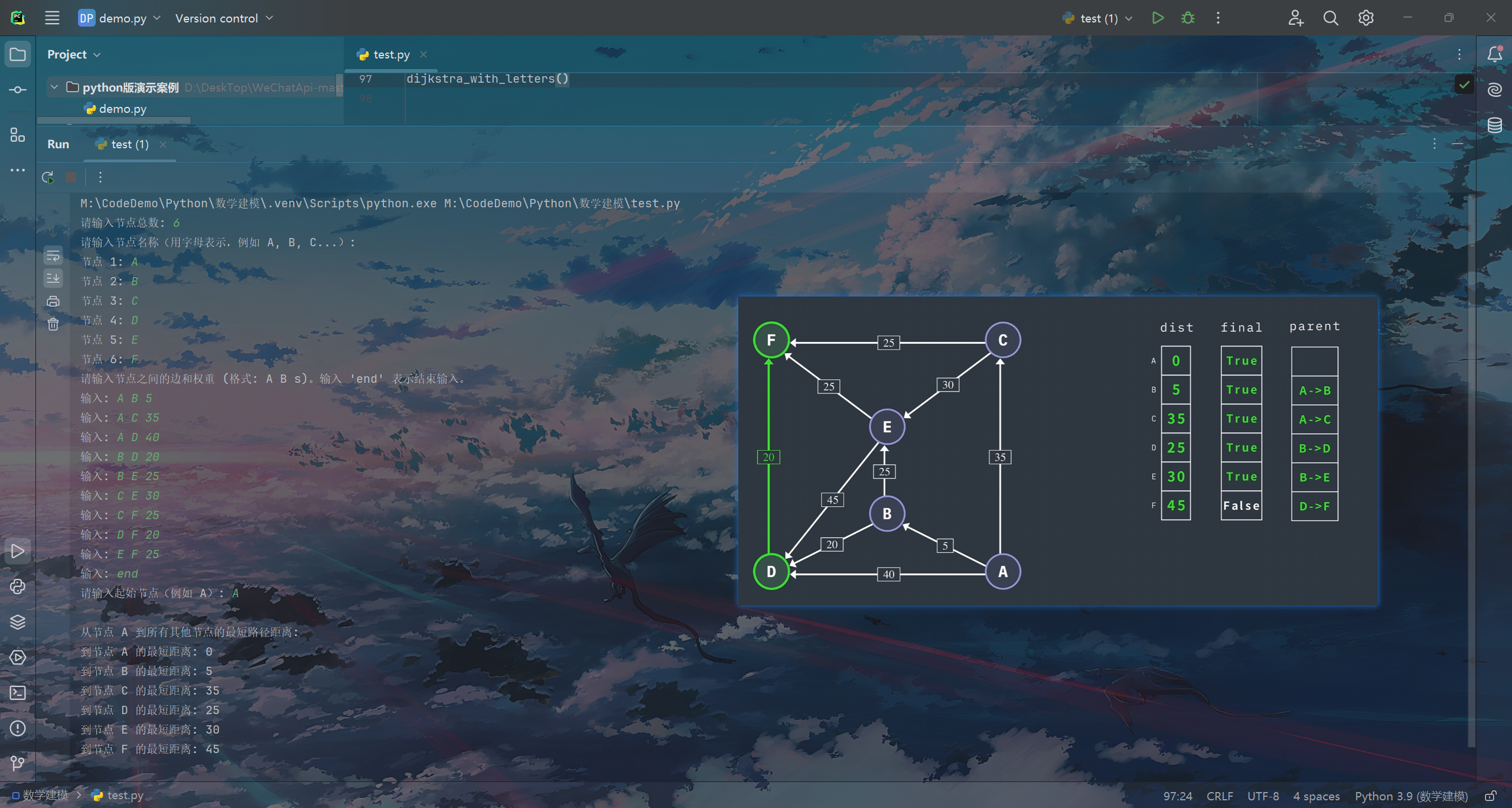
python
import heapq
from typing import Dict, List, Tuple


def dijkstra_with_letters():
    """
    使用 Dijkstra 算法计算最短路径,动态输入节点(使用字母表示)和边的信息。

    输入:
    1. 节点总数 `node_count`。
    2. 节点名称(字母表示,例如 A, B, C...)。
    3. 节点之间的边和权重,格式为: A B s (节点名称 + 权重),输入 'end' 表示结束。
    4. 起始节点(字母表示)。

    输出:
    从起始节点到所有其他节点的最短路径距离。
    """
    # 输入节点总数
    node_count = int(input("请输入节点总数: "))

    # 输入节点名称
    print("请输入节点名称(用字母表示,例如 A, B, C...):")
    nodes = [input(f"节点 {i + 1}: ").strip() for i in range(node_count)]

    # 创建节点名称到索引的映射
    node_to_index = {node: idx for idx, node in enumerate(nodes)}
    index_to_node = {idx: node for idx, node in enumerate(nodes)}

    # 初始化图的邻接表
    graph: Dict[int, List[Tuple[int, int]]] = {i: [] for i in range(node_count)}

    # 动态输入边的信息
    print("请输入节点之间的边和权重 (格式: A B s)。输入 'end' 表示结束输入。")
    while True:
        edge = input("输入: ").strip()
        if edge.lower() == "end":
            break
        try:
            a, b, s = edge.split()
            weight = int(s)
            if a in node_to_index and b in node_to_index:
                i, j = node_to_index[a], node_to_index[b]
                graph[i].append((j, weight))
            else:
                print("节点名称不存在,请重新输入。")
        except ValueError:
            print("输入格式错误,请重新输入。")

    # 输入起始节点
    start_node = input("请输入起始节点(例如 A): ").strip()
    if start_node not in node_to_index:
        print("起始节点不存在。")
        return
    start_index = node_to_index[start_node]

    # 初始化最短距离字典
    shortest_distances = {i: float('inf') for i in graph}
    shortest_distances[start_index] = 0  # 起始节点到自身的距离为 0

    # 最小堆(优先队列),存储 (距离, 节点索引)
    priority_queue = [(0, start_index)]

    # 记录已访问节点
    visited = set()

    # 核心 Dijkstra 算法
    while priority_queue:
        # 弹出距离最小的节点
        current_distance, current_node = heapq.heappop(priority_queue)

        # 如果节点已访问,跳过
        if current_node in visited:
            continue

        # 标记节点为已访问
        visited.add(current_node)

        # 遍历当前节点的邻居
        for neighbor, weight in graph[current_node]:
            distance = current_distance + weight
            # 如果找到更短路径,更新最短距离并加入队列
            if distance < shortest_distances[neighbor]:
                shortest_distances[neighbor] = distance
                heapq.heappush(priority_queue, (distance, neighbor))

    # 输出结果
    print("\n从节点 {} 到所有其他节点的最短路径距离:".format(start_node))
    for node_index, dist in shortest_distances.items():
        node_name = index_to_node[node_index]
        if dist == float('inf'):
            print(f"节点 {node_name} 无法到达")
        else:
            print(f"到节点 {node_name} 的最短距离: {dist}")


# 调用函数
dijkstra_with_letters()